By Ayobami Kehinde, Fractional RevOps Consultant & Founder, Opsly
Last updated: August 2026
TL;DR
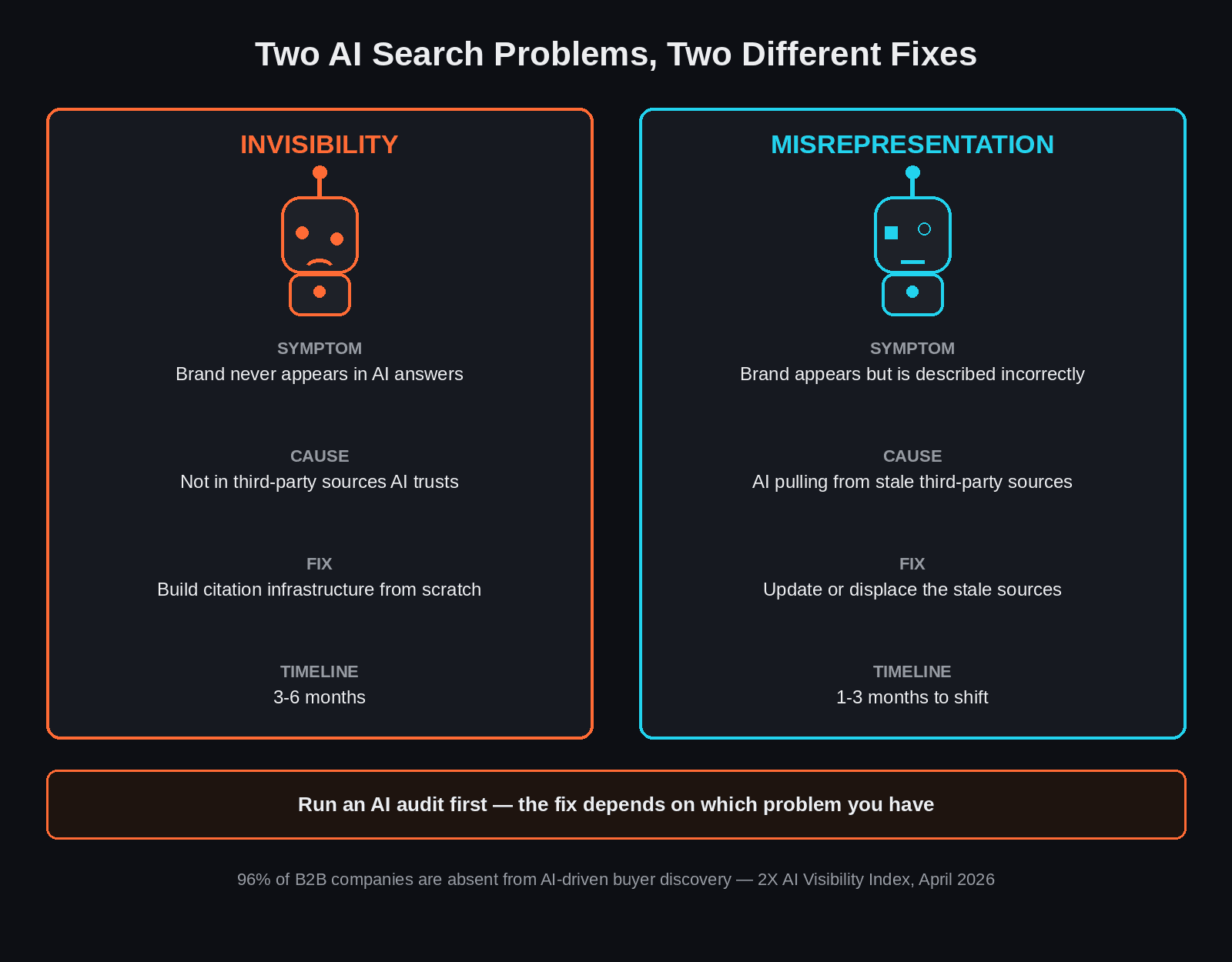
- Most B2B brands have one of two AI search problems: they are invisible, or they are named but described incorrectly.
- According to the 2X AI Visibility Index (April 2026), 96% of B2B companies receive no citation during AI-driven buyer research at all.
- Misrepresentation is harder to detect than invisibility and can actively damage conversion when buyers encounter a version of you that no longer exists.
- Each failure mode requires a different fix. Applying the invisibility fix to a misrepresentation problem burns budget on the wrong solution.
- A structured AI audit is the first step. It tells you which problem you actually have before you spend on a fix.
Buyer research has moved. According to Forrester's 2026 Buyers Journey Survey of 18,000 global buyers, 94% used AI during their most recent purchase. Before they contact your sales team, before they visit your website, buyers are querying AI engines to build their shortlist. If you are not on that shortlist, you have lost the deal before a single human conversation began.
The mistake most B2B teams make is treating AI search visibility as one problem with one solution. It is not. There are two distinct failure modes. They look different, they originate differently, and they require completely different responses. Spending on the wrong fix is one of the more common ways B2B revenue teams waste budget on GEO right now.
What does it mean to be invisible in AI search?
Invisibility in AI search means your brand never appears when AI engines answer buyer questions in your category. When a prospect asks which tools solve their problem, your name is absent. You are not ranked low. You are not mentioned at all. This happens before any human sales conversation begins.
This is the more common of the two failure modes. The 2X AI Visibility Index, published in April 2026, found that 96% of B2B companies are absent from AI-driven buyer discovery entirely. Not buried. Not ranked low. Simply not cited.
Invisibility is a structural problem. AI engines build their answers by pulling from high-authority external sources, not from your own website or product pages. According to Stacker's March 2026 analysis, 64% of all AI citations come from third-party sources, not brand-owned pages. If your brand is not being talked about in the right external contexts, the AI engine has no credible signal to draw from and therefore does not cite you.
The downstream effect is measurable. Forrester's 2026 research shows that brands affected by the shift of buyer research into AI engines are already seeing traffic declines of 10 to 40%. That drop is not a content quality problem. It is an infrastructure problem: your brand is missing from the places AI looks. According to Stacker (March 2026), 64% of AI citations originate from third-party sources, which is why investment in your own website alone cannot solve an invisibility problem.
What does misrepresentation in AI search look like?
Misrepresentation means AI engines name your brand but describe you incorrectly. Common examples: outdated pricing, discontinued services, wrong target customer, or positioning language from three years ago. The AI cites you. But the version it cites no longer reflects what you actually sell or who you sell it to.
Many B2B teams miss this failure mode because they are relieved to see their brand mentioned at all. But an incorrect description is often worse than no description. If the AI tells a buyer that your product targets enterprise teams of 500 or more, and you now serve growth-stage companies with 10 to 50 people, that buyer self-disqualifies before ever reaching your sales team. The AI pre-qualified them out on your behalf.
Misrepresentation happens because AI engines are trained on historical data and continue to pull from sources that have not been updated. A press release describing your "enterprise-first" platform. A comparison site listing a price you abandoned 18 months ago. An analyst write-up positioning you in a category you have since moved on from. All of these become AI reference points, and they persist until something more authoritative displaces them.
The most corrosive version is subtle positioning drift: your brand appears, the core facts are mostly correct, but the framing is slightly off. The AI describes you as a "workflow automation tool" when you now lead with "revenue infrastructure." To the right buyer, that framing difference is disqualifying. According to Forrester's 2026 Buyers Journey Survey, 94% of buyers used AI during their most recent purchase, which means the AI's description of your product is now a formal input into your buyer's decision process, not a footnote.
How do you know which problem your B2B brand has?
Run a structured AI audit across ChatGPT, Claude, Perplexity, and Google AI Overviews. Use the buying questions your prospects actually ask. Record whether your brand appears, what the AI says about you, and which sources it cites. That pattern tells you which failure mode you have and what to fix.
Run three types of queries. First, category queries: "what are the best tools for [your category]?" Second, problem queries: "how do B2B teams solve [the problem you solve]?" Third, comparison queries: "[your brand] versus [your main competitor]." Run each across all four engines and record the full response every time. Do not rely on memory or spot checks.
The diagnosis is in the results. If your brand does not appear in response to any query type across any engine, you have an invisibility problem. If your brand appears but the description is stale, inaccurate, or off-positioning, you have a misrepresentation problem. If your brand appears inconsistently across engines with different descriptions depending on where you ask, you likely have elements of both and should address misrepresentation first before building citation volume.
Do not skip the source documentation step. When the AI names your brand, note which third-party sources it cites as the basis for its description. That source list is your diagnostic map: it tells you exactly which external content the AI is relying on to form its view of you. The 2X AI Visibility Index (April 2026) found that 96% of B2B companies do not appear at all in AI-driven discovery, which means the majority of teams running this audit will find an invisibility problem, not a misrepresentation one.
What is the fix for invisibility vs misrepresentation?
The fix for invisibility is building third-party citation infrastructure: earning mentions in the external sources AI engines pull from. The fix for misrepresentation is correcting or displacing the stale sources the AI is already citing. These are different problems with different solutions, different budgets, and different timelines.
For invisibility, the fix is earning citations where AI engines look. That means publishing in industry media that AI engines treat as authoritative, getting your brand referenced in structured comparison content and category roundups, and building the technical foundation that makes your own content easier for AI to parse when it does surface you. This is not a content sprint. It is infrastructure work, and realistic timelines run three to six months before citation movement becomes consistent across AI engines.
For misrepresentation, the fix starts with identifying the specific sources the AI is pulling from. Some can be corrected directly: if a comparison site entry has stale data, contact the publisher and request an update. Others require a displacement strategy. You build newer, more authoritative content in the same external channels, giving the AI a better, more recent signal to prefer over the outdated one. Monitor AI responses monthly and track whether the description shifts. It will not move overnight.
The shared mistake is applying one fix to the wrong problem. Brands with misrepresentation issues often run website content sprints, publishing new pages that never get cited because the AI is already anchored to older third-party sources. Brands with invisibility issues sometimes focus on refreshing their homepage or "About" page, which has no effect on AI citation behavior for the same reason. According to Stacker (March 2026), 64% of AI citations come from third-party sources. That means the fix for both problems starts outside your own domain, not inside it.
Part of the GEO for B2B guide
This article is part of GEO for B2B: How to Go from Invisible to Cited in AI Search, the complete guide to building AI search visibility as B2B inbound infrastructure. If you are reading this cluster article first, the pillar covers every stage of the build from audit to citation strategy to monitoring.
- GEO for B2B: How to Go from Invisible to Cited in AI Search — the full pillar covering the end-to-end AI visibility build, from diagnosing your position to building citation infrastructure at scale.
- The Technical GEO Foundation: What Your Website Needs Before AI Can Cite You — covers the structural site changes your domain needs before any external citation strategy can produce consistent results.
Frequently Asked Questions
What is the difference between being invisible and being misrepresented in AI search?
Invisibility means your brand never appears when AI engines answer buyer questions in your category. Misrepresentation means AI engines do name you, but describe you incorrectly: wrong pricing, outdated positioning, or a product description that no longer reflects what you sell. Each requires a different fix, and spending on the wrong one does not move the needle.
How do I check whether my B2B brand appears in AI search?
Run a structured audit across ChatGPT, Claude, Perplexity, and Google AI Overviews. Use category queries, problem queries, and brand comparison queries. Record whether your brand appears, what the AI says about you, and which third-party sources the AI cites as its basis. That pattern tells you whether you have an invisibility problem, a misrepresentation problem, or both.
Why does AI search cite third-party sources rather than my own website?
AI engines weight third-party sources because they carry more objective signal than brand-owned content. According to Stacker's March 2026 analysis, 64% of all AI citations come from third-party sources. Your website contributes to training data, but external industry coverage, comparison sites, and media references carry significantly more weight when AI engines construct their answers about your category.
How long does it take to fix an AI search visibility problem?
Expect three to six months before citation movement is consistent for an invisibility problem. Building third-party citation infrastructure takes time to index and propagate across AI engines. Misrepresentation corrections can move faster if the source content is directly updatable, but displacement strategies, building newer signals to override stale ones, also require months of sustained effort before AI responses shift.
Can I fix AI search misrepresentation by updating my own website?
Updating your website alone rarely fixes misrepresentation. If the AI is citing third-party sources for its description of you, a refreshed About page or new case study will not change the AI's output. The fix requires identifying which external sources the AI relies on and either updating those directly or building more authoritative third-party content that displaces the outdated signals over time.