By Ayobami Kehinde, Fractional RevOps Consultant and Founder, Opsly. Last updated: August 2026.
TL;DR
- Most B2B teams try to fix AI search visibility with more content. The real block is technical infrastructure, not output volume.
- AI crawlers cannot cite a site they cannot properly read. llms.txt, schema markup, and correct robots.txt permissions are the starting point.
- 96% of B2B companies are invisible during AI-driven buyer discovery (2X AI Visibility Index, April 2026). For most, that starts at the technical layer, not the content layer.
- Without structured data, AI systems guess what your brand does. They will cite a competitor with better-formatted pages instead.
- Fix the technical foundation first. Content and links compound on top of working infrastructure, not the other way around.
What is the technical GEO foundation?
The technical GEO foundation is the infrastructure layer that lets AI crawlers access, read, and cite your website. It covers llms.txt, schema markup, robots.txt permissions, structured content hierarchy, canonical tags, and page speed. Without it, even strong content will be overlooked by AI systems in favour of better-formatted sources.
GEO stands for Generative Engine Optimization. It is the practice of making your brand visible in AI-generated answers, not just traditional search results. ChatGPT, Claude, Perplexity, and Google AI Overviews all pull from indexed web content. But they do not read the web the way a human browses it. They parse structured signals. If those signals are missing or broken, your content does not make it into the answer.
Most B2B brands assume this is a content problem. They write more articles, polish their messaging, and wait. The traffic does not come. The problem was never content. It was infrastructure.
According to the 2X AI Visibility Index (April 2026), 96% of B2B companies are invisible during AI-driven buyer discovery. That number is not explained by content quality alone. It is a structural problem, and it starts at the technical layer.
AI systems primarily cite from the first third of a text, according to the Surfer SEO AI Visibility Guide 2026. If your key claims are buried below three paragraphs of preamble, or hidden behind JavaScript rendering issues, they will not surface in an AI-generated answer.
What is llms.txt and does your B2B site need one?
llms.txt is a plain text file placed at the root of your website that tells AI systems what your company does, which pages are most important, and what context to use when generating answers about your brand. If your B2B site does not have one, AI tools are guessing your positioning from fragments of your homepage and whatever third-party sources they can find first.
The format is simple. A typical llms.txt includes a short company description, a list of key URLs with one-line summaries, and any guidance on how your content should be interpreted. It is the AI-native equivalent of a precise company profile, placed exactly where crawlers expect to find it.
Think of it this way: robots.txt controls access. llms.txt controls understanding. Both matter for GEO.
For B2B brands, the positioning risk is significant without it. If a buyer asks ChatGPT "who handles revenue operations for B2B SaaS companies," the answer is shaped by whatever context AI systems have already absorbed about your brand. If that context comes entirely from analyst aggregators, review sites, or outdated LinkedIn posts, the description will be approximate at best. llms.txt gives you a direct channel to correct the record.
Opsly implements llms.txt as a standard first step in every technical GEO audit. It takes under an hour to build correctly and has an immediate effect on how AI systems frame the brand in queries.
64% of all AI citations come from third-party sources rather than brand-owned pages, according to Stacker (March 2026). Your llms.txt needs to be accurate enough that AI systems are not importing incorrect positioning from sources you do not control.
What schema markup does AI search need to cite your brand?
AI search systems rely on structured data to understand what a page is, who wrote it, and whether the information is credible. For B2B websites, the minimum viable schema set is Organisation, WebPage, Article, and FAQPage. These four types tell AI crawlers exactly what your content contains and make accurate citation far more likely.
Organisation schema is the foundation. It declares your company name, website URL, logo, founder, and business description in a format AI systems can parse directly. Without it, AI tools have to infer your business type and positioning from homepage text, and they often get it wrong, especially for specialist B2B brands that do not fit a simple category label.
WebPage schema clarifies what each page is about. Article schema marks editorial content as authored, dated, and attributable. Both matter. But FAQPage schema is the type most directly connected to AI citations: it marks up questions and answers in a format that AI systems are built to extract and repeat.
The minimum viable schema stack for a B2B site looks like this:
- Organisation: company name, URL, founder, description, logo, social profiles
- WebPage: on every page, with name, URL, and description fields populated
- Article: on every blog post, with headline, author, datePublished, and dateModified
- FAQPage: on any page with a questions-and-answers section, including blog posts
All of this is embedded as JSON-LD in the head of your pages. It does not change what human visitors see. It changes what AI systems see when they read your source code.
Sites without structured data are harder for AI systems to parse, and poorly structured pages are more likely to be misrepresented in AI-generated answers, according to the Surfer SEO AI Visibility Guide 2026. Schema markup is not optional infrastructure. It is the signal layer that makes accurate citation possible.
Is your robots.txt blocking AI crawlers without you knowing?
Yes, and it is more common than most B2B teams expect. Many websites have robots.txt configurations that block AI crawlers, either inherited from legacy SEO setups or applied by a developer managing server load. If GPTBot, ClaudeBot, PerplexityBot, or Google-Extended are blocked, those systems cannot read your site at all. No content strategy fixes that.
Check your robots.txt file right now. Visit yourdomain.com/robots.txt and look for these user-agent entries:
- User-agent: GPTBot
- User-agent: ClaudeBot
- User-agent: PerplexityBot
- User-agent: Google-Extended
If any of them carries a Disallow: / rule underneath, that crawler cannot access your site. It cannot read your content. It cannot cite you. Some sites trigger this accidentally through wildcard rules: a User-agent: * block with broad Disallow settings catches AI crawlers along with the rest.
The fix is direct. Add explicit Allow entries for each AI crawler. A clean configuration looks like this:
User-agent: GPTBot
Allow: /
User-agent: ClaudeBot
Allow: /
User-agent: PerplexityBot
Allow: /
User-agent: Google-Extended
Allow: /
If there are sections of your site you need to keep private, such as login portals or internal dashboards, exclude those paths specifically rather than applying a broad block across the domain.
According to the Surfer SEO AI Visibility Guide 2026, blocking AI crawlers in robots.txt while expecting AI visibility is one of the most common technical errors found in early-stage GEO audits. Check this before anything else. It takes five minutes and is one of the highest-impact single changes a B2B site can make.
What else does the technical GEO checklist cover?
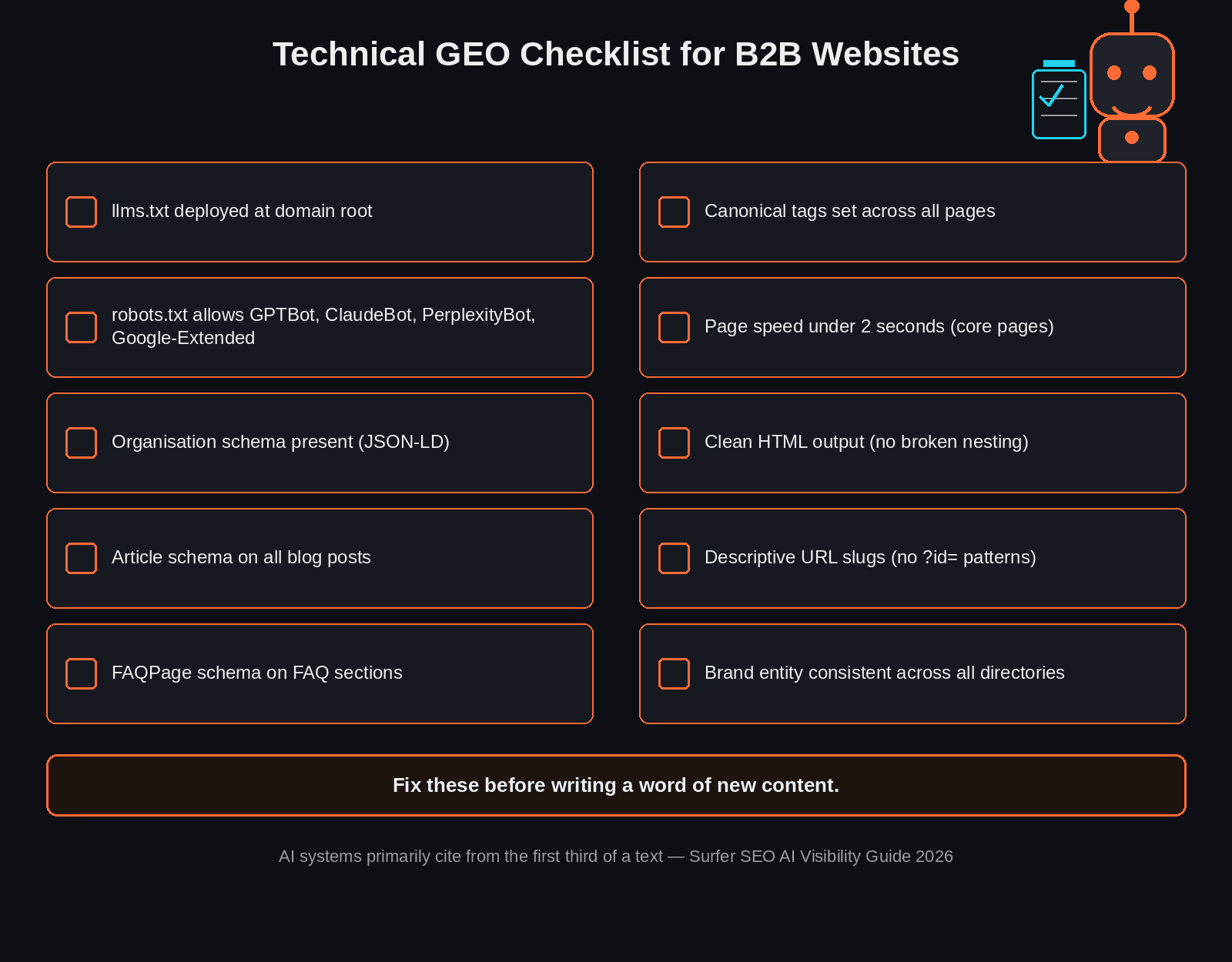
Beyond llms.txt, schema markup, and robots.txt, a complete technical GEO foundation includes canonical tags, structured content hierarchy, page speed, and clean HTML rendering. Each one affects how reliably AI systems can read, extract, and attribute information from your pages.
Canonical tags. If you have duplicate or near-duplicate content across multiple URLs, AI systems may cite the wrong version or dilute citation signals across both. Canonical tags tell crawlers which URL is the definitive source. For B2B sites with product pages, category pages, or regional variations, this matters more than most teams realise.
Structured content hierarchy. AI systems cite from the first third of a text (Surfer SEO AI Visibility Guide 2026). Your most important claims, your direct answers, and your brand differentiators need to appear at the top of the page. Not after three paragraphs of scene-setting. Not below a video embed. At the top, in the first paragraph.
Page speed and crawlability. Slow pages or JavaScript-heavy rendering means AI crawlers may time out before they finish reading your content. Server-side rendering or static generation is strongly preferable for pages you want cited. Core pages, including your homepage, product pages, and key blog posts, should load in under two seconds.
Clean HTML output. AI systems read HTML, not visual layouts. A page that looks polished in a browser but outputs broken or deeply nested HTML is harder to parse. Check your rendered HTML with a page source view or a crawl tool to confirm the structure reflects the intent.
URL structure. Clean, descriptive URLs help AI systems understand page context before reading a single word of the content. /blog/technical-geo-foundation-b2b communicates intent. /blog?id=4821 communicates nothing.
This is the foundation. Once it is in place, every piece of content you publish has a surface to land on. Every backlink you earn points to a page AI systems can actually use. 96% of B2B companies are currently invisible during AI-driven buyer discovery, according to the 2X AI Visibility Index (April 2026). Technical gaps in crawlability and structured data are a primary driver of that number.
This article is part of the GEO for B2B series
- GEO for B2B: How to Go from Invisible to Cited in AI Search: the full picture on what GEO is and why it matters for B2B revenue teams. This article is a cluster within that guide.
- Not in the Answer, or Named Incorrectly: How to Tell Which AI Search Problem You Have: if you are unsure whether your brand is absent or misrepresented in AI answers, start with this diagnostic.
- What AI Actually Needs to Recommend Your B2B Brand (It's Not More Content): once the technical layer is working, this is what shapes how AI systems describe and recommend you.
Frequently asked questions: technical GEO for B2B websites
What is the difference between technical SEO and technical GEO?
Technical SEO optimises a site for search engine crawlers and ranking algorithms. Technical GEO optimises for AI systems that generate answers rather than return links. They overlap on page speed and crawlability, but GEO adds llms.txt, AI-specific schema types, and explicit permissions for AI crawlers that traditional SEO configurations do not cover.
How do I check if AI crawlers can access my B2B site?
Visit yourdomain.com/robots.txt and look for GPTBot, ClaudeBot, PerplexityBot, and Google-Extended in the user-agent list. If any carries a Disallow: / rule, that crawler is blocked. You can also use Bing Webmaster Tools or a crawl simulator to test specific bot access against your current configuration.
Does llms.txt actually influence where AI systems pull information from?
llms.txt signals which pages are authoritative and what context to use when generating answers about your brand. It does not guarantee citation, but it reduces the risk of AI systems importing incorrect positioning from third-party sources. For B2B brands with specialist positioning, the absence of llms.txt is a meaningful gap that direct competitors can fill.
What schema markup should a B2B site prioritise first?
Start with Organisation schema on your homepage and Article schema on every blog post. Add FAQPage schema to any page with a questions-and-answers section. WebPage schema rounds out the core set. All four types can be embedded as JSON-LD without any change to what human visitors see on the page.
How long does a technical GEO audit and implementation take?
For a typical B2B website, a technical GEO audit takes two to three hours. Implementing the fixes, including llms.txt, schema markup, and robots.txt corrections, takes one to two additional days depending on the CMS and codebase accessibility. Most sites see crawlability improvements confirmed within one to two weeks of implementation.