By Ayobami Kehinde, Fractional RevOps Consultant & Founder, Opsly
Last updated: August 2026
Most B2B companies respond to AI invisibility the same way. They publish more. More blogs, more case studies, more thought leadership. It does not work. Not because the content is bad. Because the problem is upstream of the content.
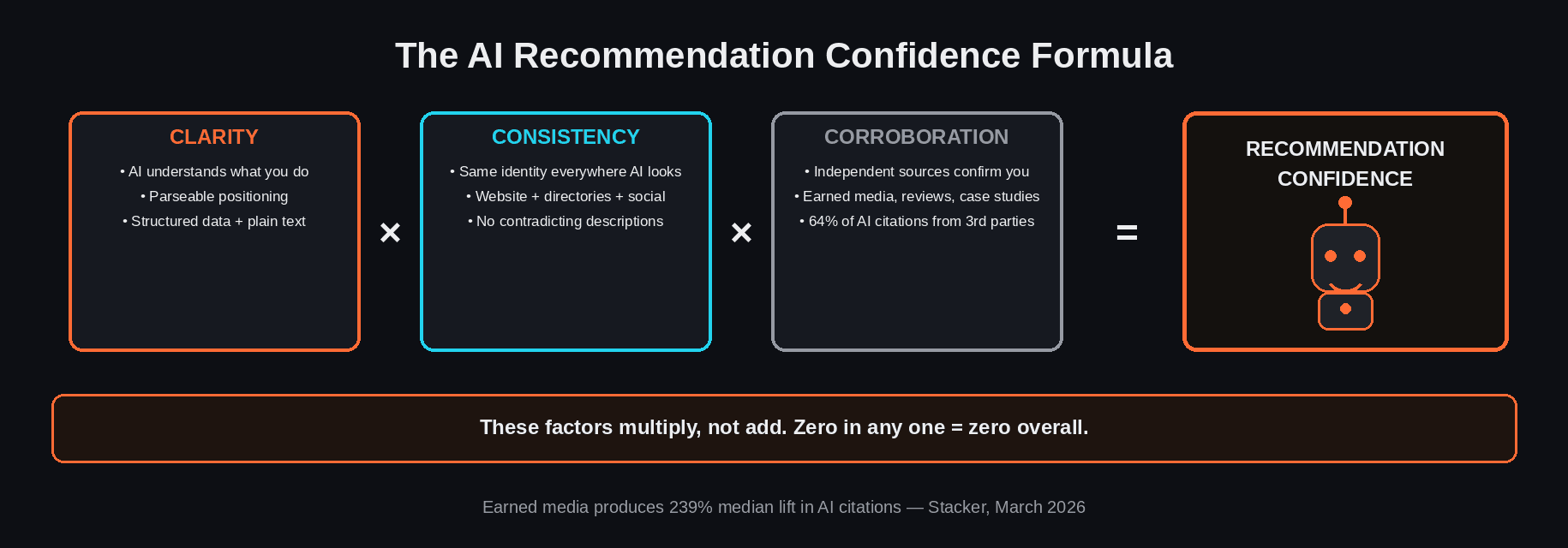
AI systems do not just find your brand. They form a judgment about your brand before deciding whether to recommend it. That judgment comes down to three structural factors: Clarity, Consistency, and Corroboration. Publishing more content does not fix any of them.
TL;DR
- AI does not passively find your brand. It builds a confidence judgment about you by assembling signals from across the web before deciding whether to recommend you.
- That judgment depends on three factors: Clarity (AI can understand exactly what you do), Consistency (the same identity appears everywhere AI looks), and Corroboration (independent sources confirm what you claim).
- These three factors multiply. A gap in any one of them collapses the impact of the other two.
- 96% of B2B companies are currently invisible during AI-driven buyer discovery, according to the 2X AI Visibility Index, April 2026.
- The fix is structural, not editorial. Publishing more content into a broken foundation produces more invisible content.
What does AI search actually evaluate before recommending a brand?
AI engines do not rank pages. They build confidence judgments. Before recommending a brand, an AI system assembles signals from your website, third-party directories, press coverage, partner pages, and social profiles. If those signals conflict or leave critical gaps, the AI does not take a risk. It skips your brand and names one it can place with confidence.
This matters because the channel has shifted. When a B2B buyer asks ChatGPT or Perplexity which vendor can solve their problem, the AI is not browsing your blog in that moment. It is drawing on a pre-formed picture of your category, assembled from everything it has processed about your brand across the open web. That picture either supports a confident recommendation or it does not.
Traditional SEO trained most B2B marketers to optimise individual pages. AI recommendation works differently. An AI system is not evaluating a single page. It is evaluating the coherence of your entire digital presence, the quality of external signals pointing at you, and the degree to which independent sources corroborate what you say about yourself.
The three-layer framework that determines recommendation confidence is Clarity multiplied by Consistency multiplied by Corroboration. These factors do not add up. They multiply. A score of zero in any one of them produces a result of zero overall. According to CompetLab's 2026 research, 73% of B2B buyers now use AI tools in their research process, which makes the cost of an invisible brand higher than most founders have calculated.
What is Clarity and why does a vague identity kill AI recommendations?
Clarity means AI can understand exactly what your business does from the signals available to it. This is not about having a well-designed website. It is about whether your website, your listings, and your content give AI an unambiguous, parseable description of your service, your target customer, and the outcome you deliver. Vague positioning is unprocessable positioning.
The most common Clarity failure in B2B is positioning that sounds like every other company in the category. "We help companies grow revenue" fits hundreds of vendors. When AI encounters it, it has no basis for a specific recommendation. Your brand becomes a generic entry that cannot be cited confidently in response to a specific buyer query.
Clarity starts with your core pages. Your homepage, about page, and service pages need to answer four questions in plain text: what you do, who you do it for, what outcome you produce, and why that outcome matters to this specific customer type. Those answers need to appear in text AI can parse, not locked inside images, PDFs, or JavaScript-rendered components that AI crawlers cannot reliably access.
The technical layer compounds the effect. Structured data, specifically schema.org markup for your organisation, services, and FAQ content, gives AI a machine-readable version of your identity on top of the human-readable prose. Without it, AI is inferring your identity from unstructured text. Inference introduces error. Error introduces uncertainty. Uncertainty produces silence. According to the 2X AI Visibility Index, April 2026, 96% of B2B companies are invisible during AI-driven buyer discovery, and the majority of those failures trace back to a brand identity that AI cannot parse accurately at the foundation.
What is Consistency and why do conflicting descriptions confuse AI?
Consistency means the same brand identity appears across every source AI can reach. Your website, your Google Business Profile, your LinkedIn company page, industry directories, partner pages, and press mentions should all describe what you do in coherent, compatible terms. When they conflict, AI loses confidence in the description. And an AI without confidence does not recommend.
This is more common than most founders expect. Companies update their website after a positioning shift and leave their LinkedIn summary, their G2 profile, and their third-party directory entries unchanged. The result is multiple versions of the company identity living simultaneously across the web. AI assembles all of them and finds contradiction. It interprets contradiction as unreliability.
The compounding effect is significant. If your company name appears differently across sources, if your service descriptions use incompatible language, or if your team size or founding date conflicts between platforms, each discrepancy reduces AI confidence in your brand description. A company with five contradictory descriptions across five sources is not five times more visible. It is five times more confusing to the system that determines whether your name appears in the answer.
The fix is an audit, not a content campaign. Map every place your brand identity appears across the web. Standardise the language, the descriptions, and the factual claims. This is infrastructure work. It does not produce content. It produces a coherent signal that AI can read without contradiction. Inconsistent brand signals across external sources damage AI recommendation confidence in the same way conflicting CRM data corrupts pipeline forecasting, and 73% of B2B buyers are now using AI to research vendors according to CompetLab's 2026 data, which means the cost of that damage is compounding every quarter.
What is Corroboration and why does self-description have a ceiling?
Corroboration is the hardest layer to build and the most important to understand. It means sources you do not control confirm what you claim. AI systems distinguish between a company describing itself and a third party describing the same company. Self-description carries less weight. Independent corroboration carries significantly more.
The data is direct. According to Stacker research published in March 2026, 64% of all AI citations come from third-party sources, not brand-owned pages. A business that publishes exclusively on its own domain is fighting for the minority of AI citations. That is not a content quality problem. It is a signal source problem.
Corroboration comes from several source types, each carrying different weight. Press coverage and editorial media mentions are high signal. Guest articles on credible industry publications carry strong independent authority. Customer reviews on established platforms such as G2, Clutch, and Trustpilot add corroborating accounts from real buyers. Case studies hosted by clients or partners, rather than solely on your own site, provide context that AI treats as externally validated.
The strategic implication is that your content calendar and your earned media strategy are two separate infrastructure layers. Owned content builds Clarity. Earned and third-party content builds Corroboration. Neglecting the second layer means your Clarity work hits a ceiling, regardless of how much you publish. This is where the equation breaks in the way most B2B brands do not expect: you can have perfect Clarity and clean Consistency, but if no source outside your own domain is confirming your story, the AI recommendation confidence stays low. According to Stacker research from March 2026, earned media produces a 239% median lift in AI citations compared to owned content alone, which quantifies precisely how much additional weight independent sources carry over what you publish yourself.
How do you audit your B2B brand's AI reputation?
An AI reputation audit starts in three places: what AI can read on your site, what it finds when it looks outside your site, and whether the two pictures are coherent. Run this sequence before changing a single piece of content. The audit identifies the structural failure. Content and outreach decisions come after you know which layer is the problem.
Start with your own site. Check that your homepage, about page, and service pages contain clear, text-based descriptions that directly answer who you serve and what outcome you deliver. Verify that structured data is present and valid. Check that no critical identity claims are locked inside images or loaded by JavaScript after the page renders, since AI crawlers may not execute client-side rendering reliably.
Then check what AI finds externally. Search your company name across the major directories where AI pulls signals: Google Business Profile, LinkedIn, Crunchbase, Clutch, G2, and any sector-specific platforms relevant to your market. Note every variation in how your company is described. Flag any inconsistency in name format, service description, founding date, or team size. Each inconsistency is a Consistency failure that reduces recommendation confidence.
Then audit your third-party footprint. How many independent sources reference your company? Are they authoritative within your category? Do they corroborate your core positioning claims? If the answer is mostly your own blog and one press release you distributed yourself, your Corroboration layer is at floor level. No volume of additional owned content lifts it. What lifts it is a deliberate strategy for earning independent mentions, reviews, and coverage from sources AI treats as credible. According to the 2X AI Visibility Index, April 2026, 96% of B2B brands are invisible during AI-driven buyer discovery, and closing that gap starts with the structural audit that pinpoints which layer is causing the failure.
This article is part of the GEO for B2B series. The pillar covers the full infrastructure framework from technical foundation through to earned signals.
- GEO for B2B: How to Go from Invisible to Cited in AI Search: the full pillar covering the complete AI visibility framework, including how Clarity, Consistency, and Corroboration fit into a system you can build systematically.
- Not in the Answer, or Named Incorrectly: How to Tell Which AI Search Problem You Have. Clarity, Consistency, and Corroboration failures each produce a different symptom in AI search. This post shows you how to diagnose which one you are dealing with before you build anything.
- The Technical GEO Foundation: What Your Website Needs Before AI Can Cite You. The technical implementation layer that underpins Clarity. Read this before changing your schema or site structure.
Frequently asked questions about AI reputation in B2B
What is AI reputation for a B2B brand?
AI reputation is the confidence judgment an AI system forms about your brand based on signals it can find across the web. It is not a score or a ranking. It is the degree to which AI can describe your company accurately and stake a recommendation on that description. A brand with strong AI reputation gets named. A brand with weak AI reputation gets skipped, regardless of how much it publishes.
Why does publishing more content not improve AI visibility?
More content adds more owned signals, but AI weights third-party sources more heavily than brand-owned pages. If your Clarity or Consistency layers have structural gaps, additional content does not fix them. And if your Corroboration layer is thin, publishing more on your own domain does not add the independent signals AI needs to recommend you. According to Stacker research from March 2026, 64% of AI citations already come from third-party sources, not owned content.
What is the Clarity, Consistency, Corroboration framework?
It is a diagnostic framework for auditing AI reputation. Clarity means AI can understand precisely what your business does. Consistency means the same identity appears across every source AI can reach. Corroboration means independent third-party sources confirm your claims. The three factors multiply rather than add. Weakness in any one suppresses the impact of the other two and reduces overall AI recommendation confidence.
How important are third-party sources for AI recommendations?
Critical. According to Stacker research from March 2026, 64% of all AI citations come from third-party sources rather than brand-owned pages, and earned media produces a 239% median lift in AI citations compared to owned content alone. The sources you do not directly control carry far more weight with AI than anything you publish on your own domain.
How do you know if your B2B brand has an AI reputation problem?
Run a direct test. Ask ChatGPT, Perplexity, and Claude to name companies in your category. If your brand does not appear, you have an AI visibility problem. Then ask an AI to describe what your company does. If the description is vague, wrong, or generic, you have a Clarity or Consistency problem. Start the structural audit from that diagnostic, not from your content calendar.