By Ayobami Kehinde, Fractional RevOps Consultant and Founder, Opsly | Last updated: August 2026
Ayobami Kehinde is the founder of Opsly. With a background spanning software engineering, sales operations, and AI automation, he builds the revenue infrastructure that connects marketing, sales, and customer success for scaling B2B teams.
- 96% of B2B brands are invisible when AI tools answer buyer questions, according to the 2X AI Visibility Index (April 2026). Most of them do not know it yet.
- 94% of B2B buyers used AI during their most recent purchase, according to Forrester's 2026 Buyers Journey Survey of 18,000 global buyers. That is not a trend. That is the current state.
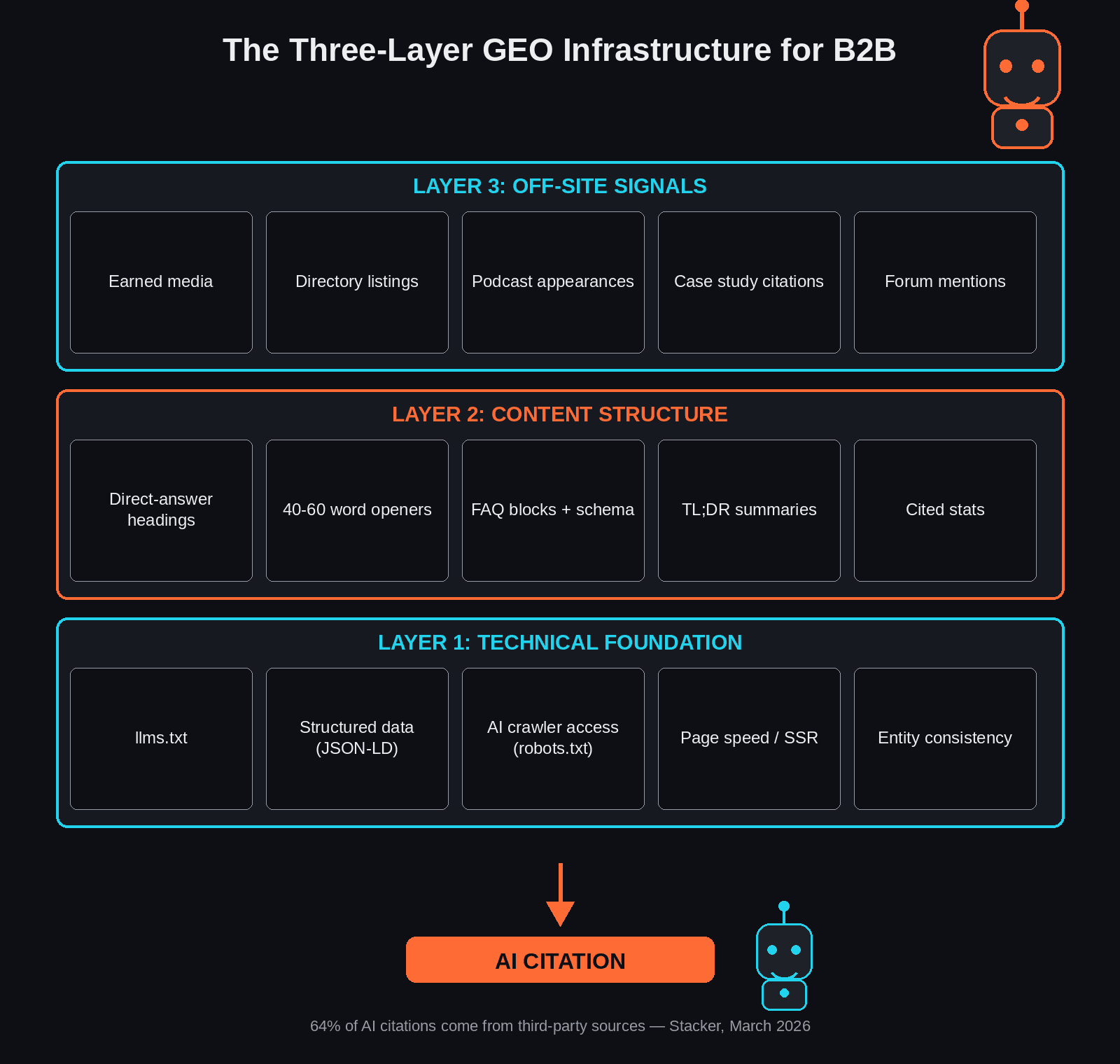
- Invisibility is not a content problem. It is an infrastructure problem with three layers: technical foundation, content structure, and off-site signals.
- AI-referred visitors convert at 23x higher rates than organic search visitors, making AI citation a direct revenue lever.
- GEO does not replace SEO. It is the parallel inbound infrastructure story. Both need fixing. Neither can wait.
What is GEO for B2B?
GEO, or Generative Engine Optimisation, for B2B is the process of structuring your technical infrastructure, content, and third-party presence so that AI systems such as ChatGPT, Claude, Perplexity, and Google AI Overviews can find, understand, and cite your brand when buyers ask relevant questions. It is not a rebranding of SEO. It is the infrastructure layer that determines whether you exist in AI-generated answers at all.
Your buyers are already using AI instead of Google for vendor research. They type "best RevOps consultants for a 30-person B2B SaaS team" into ChatGPT, or "compare fractional RevOps providers in the UK" into Perplexity. If your brand does not appear in those answers, you are not losing a click. You are being excluded from the consideration set before a buyer ever visits your website.
You are already generating revenue. The systems underneath, including the infrastructure that controls how AI perceives and describes your brand, have not caught up. GEO for B2B is the systematic practice of fixing that gap. It covers three layers. Technical: making your site readable by AI crawlers. Content: structuring what you publish so AI can extract and cite it. Off-site: building the third-party mention network that signals authority to AI systems. Each layer has specific, auditable inputs. None of them are optional if you want to be cited consistently.
According to Similarweb's 2026 data, AI chatbot platforms now receive 650 million monthly visitors, up 57% year over year, making them a mainstream research channel that no B2B brand can afford to treat as a future consideration.
Why are 96% of B2B brands invisible in AI search?
The 2X AI Visibility Index, published in April 2026, found that 96% of B2B companies are invisible during AI-driven buyer discovery. That number is not surprising once you understand how AI systems decide what to cite. The reasons B2B brands get skipped are specific, fixable, and almost never about the quality of the product or service itself.
There are four structural reasons most B2B brands are absent from AI-generated answers.
AI crawlers cannot read your site
Most B2B websites were built for human visitors and Google's crawlers. AI systems use different agents with different rules. If your robots.txt blocks those agents, if your JavaScript-heavy pages render nothing before a crawler's extraction window closes, or if you have no llms.txt file to tell AI what your site contains, AI systems cannot extract reliable information about your brand. Invisibility starts here, before any piece of content is evaluated.
Your content does not answer questions directly
AI systems retrieve content that directly answers the questions buyers ask. They do not read long-form narrative prose and infer the answer from paragraph four. If your website pages are structured around your company story rather than around the specific questions your buyers are typing into AI tools, there is nothing extractable for AI to cite. A homepage that leads with "We help ambitious companies grow" gives AI nothing to work with when a buyer asks "What does Opsly do for B2B RevOps teams?"
Third-party sources do not mention you
Stacker's March 2026 research found that 64% of all AI citations come from third-party sources, not brand-owned pages. AI systems treat external mentions as trust signals. If your brand appears only on your own website, AI has no corroborating evidence to validate your claims. From the AI system's perspective, you are self-reported and unverified. That is not a citation. That is a risk it avoids.
Your brand entity is unclear or inconsistent
AI systems build an understanding of your brand from signals across the web. If your company name is spelled differently across directories, your description varies from platform to platform, and your category positioning is inconsistent, AI cannot form a stable entity understanding of who you are and what you do. Inconsistency reads as noise. AI systems default to citing the more consistent signal, which is usually a competitor who has done the infrastructure work.
Forrester's 2026 Buyers Journey Survey, covering 18,000 global buyers, found that 94% used AI during their most recent purchase, making brand invisibility in AI a direct sales pipeline problem, not a future-state consideration to plan for later.
How does GEO differ from SEO?
SEO targets keyword rankings in Google's blue-link results. GEO targets AI-generated answers in ChatGPT, Claude, Perplexity, and Google AI Overviews. Both matter. The technical foundations overlap, but the optimisation priorities diverge enough that treating GEO as "SEO with a new name" causes brands to invest in the wrong places and measure the wrong outcomes.
| Factor | SEO | GEO |
|---|---|---|
| Primary target | Google keyword rankings | AI-generated answers |
| Content signal | Keyword relevance, backlinks | Direct-answer structure, citation density |
| Technical priority | Core Web Vitals, indexability | AI crawlability, llms.txt, structured data |
| Off-site priority | Domain authority backlinks | Third-party brand mentions, earned media |
| Measurement | Ranking positions, organic traffic | Citation frequency, AI referral traffic, share of voice |
| Speed of signal | Weeks to months | 60 to 90 days for initial visibility |
The critical point to take from that comparison: GEO does not replace SEO. Brands that win AI search are also strengthening their Google performance because both depend on technical health, structured content, and third-party authority. The mistake is treating them as competing budget decisions rather than parallel infrastructure investments that share the same foundation work. Investing in one compounds performance in the other.
Forrester's 2026 data shows that brands already experiencing 10 to 40% organic traffic declines, as buyer research shifts into AI engines, are the same brands that underinvested in technical and content infrastructure across both channels at the same time.
What is the three-layer GEO infrastructure for B2B?
Going from invisible to cited in AI search is an infrastructure problem. It has three distinct layers, and they must be built in sequence. Skipping the technical layer and jumping straight to content is one of the most common mistakes B2B brands make in this space. Content structured for AI citation is wasted if AI crawlers cannot reach it. Get the foundation right first. Everything else gets easier from there.
Layer 1: Technical foundation
The technical layer determines whether AI systems can find and read your brand at all. Without it, the content and off-site layers have no reach regardless of how well they are built.
- llms.txt: A plain-text file at your domain root that tells AI systems what your site contains, who you are, and which pages are most important. Without it, AI crawlers make their own decisions about what to index and often miss your most relevant content entirely.
- Structured data (JSON-LD): Schema markup for your organisation, products, services, FAQs, and articles. Structured data is machine-readable by design. AI systems weight it heavily because it removes ambiguity from what you do, who you serve, and how you describe yourself.
- AI crawler access: Verify your robots.txt is not blocking known AI agents including GPTBot, ClaudeBot, PerplexityBot, and Googlebot-Extended. A single misconfigured directive can prevent an entire platform from reading your site completely.
- Page speed and render stability: AI crawlers allocate limited time per page. JavaScript-heavy pages that take four seconds to render content lose their extraction window before anything useful is retrieved. Fast, server-rendered HTML is preferable to client-side rendering for AI readability.
- Entity consistency: Your brand name, description, category, and founding details should match precisely across your website, Google Business Profile, Crunchbase, LinkedIn, and any industry directories. Inconsistency creates entity ambiguity that AI systems resolve by citing a more consistent competitor instead of you.
The full technical checklist, including crawl verification steps and structured data templates, is covered in depth in the companion article: The Technical GEO Foundation: What Your Website Needs Before AI Can Cite You. According to the 2X AI Visibility Index (April 2026), most B2B brands have critical gaps at the technical layer before any content work is considered.
Layer 2: Content structure
Once AI can reach your site, the content layer determines whether AI has anything worth extracting and citing. Standard B2B content, narrative-led blog posts and service pages written for human reading flow, is poorly formatted for AI extraction. Structured, direct-answer content is significantly more likely to appear in AI-generated responses.
- Direct-answer headings: Every section heading should be a question your buyers actually type into AI tools. AI systems use headings as retrieval anchors. Generic headings such as "Our Approach" or "What We Do" give AI nothing to match against a specific buyer query.
- 40 to 60 word direct-answer openers: The first paragraph under every heading should answer the question completely, in plain language, before adding context or nuance. AI systems extract the opener. If the actual answer is buried in paragraph three, it gets skipped in favour of a competitor's cleaner structure.
- FAQ sections in semantic HTML: Explicitly structured FAQ blocks signal extractable, question-and-answer content to AI systems. Paired with FAQPage schema markup, they function as a curated knowledge source that AI retrieves with high priority when matching buyer queries.
- Stat-dense, cited content: AI systems cite content that cites sources. Referencing named research with specific figures signals credibility and increases the probability that AI will use your content as a source when answering related questions. Anonymous statistics get ignored.
- TL;DR summaries: A bulleted summary at the top of every long-form piece gives AI a compressed, extractable version of the full article. This is often the text that surfaces in AI-generated answers when your content is cited by an AI platform.
Earned media produces a 239% median lift in AI citations, according to Stacker's March 2026 research, but that lift only materialises when the underlying content being cited meets these structural requirements from the ground up.
Layer 3: Off-site signals
The third layer is the one most B2B brands neglect entirely, and it carries the most weight in AI citation decisions. Stacker's March 2026 research found that 64% of all AI citations come from third-party sources, not brand-owned pages. AI systems treat external mentions as corroboration. Without them, your brand's claims are self-reported and unverifiable. That is not a position from which AI systems comfortably cite you.
Off-site signals that drive AI citation for B2B brands include:
- Earned media coverage: Articles in industry publications, trade press, and news outlets that mention your brand by name in relevant context.
- Analyst and directory listings: G2, Capterra, Clutch, and equivalent directories in your category. AI systems query these platforms when constructing category overviews and vendor comparisons for buyer queries.
- Podcast and video appearances: Transcripts from podcast episodes and YouTube videos mentioning your brand create text-indexed content that AI systems can retrieve. A founder interview on a relevant industry podcast is a durable GEO asset that compounds over time.
- Case study citations: When partners or clients publish case studies that name your brand and describe specific outcomes you delivered, those are high-trust third-party corroboration signals.
- Community and forum mentions: Mentions on Reddit, LinkedIn, and industry forums with high crawl priority. AI systems increasingly weight what real users say about a brand, not just what the brand says about itself.
AI-referred visitors convert at 23x higher rates than organic search visitors, according to Mersel AI's 2026 research, which means the commercial case for investing in off-site GEO signals is significantly stronger than equivalent investment in traditional link building or paid search.
How long does it take to go from invisible to cited in AI search?
Most B2B brands see initial AI citation improvements within 60 to 90 days of fixing their technical foundation and publishing structured content. Full citation authority across major AI platforms typically builds over 6 to 12 months, depending on how broken the current technical foundation is, how much third-party mention history the brand already has, and how consistently structured content is published going forward.
Days 1 to 30: Fix the technical foundation
Audit and fix the technical layer first. Deploy llms.txt. Fix robots.txt. Implement JSON-LD structured data for your organisation and key service pages. Repair entity consistency issues across directories and listings. Verify AI crawler access across all major platforms. This phase produces no visible content output but has the highest impact of any stage.
Days 31 to 90: Publish structured content
Restructure or rewrite your highest-priority pages for direct-answer format. Add FAQ sections with semantic HTML markup and FAQPage schema. Build out pillar and cluster content around the specific questions your buyers are asking AI tools. Each piece should include a TL;DR, direct-answer headings, and inline citations from named authority sources.
Days 91 to 180: Build off-site signals
Begin the earned media and third-party mention programme. Target relevant industry publications for contributed articles. Pursue podcast appearances, directory listings, and analyst coverage relevant to your category. Each external mention compounds the off-site signal layer.
Month 6 and beyond: Compound and measure
At six months, audit your AI citation frequency across ChatGPT, Claude, Perplexity, and Google AI Overviews for your target topics. Measure referral traffic from AI platforms in your analytics. Track share of voice in AI responses against two or three direct competitors. Use those metrics to prioritise the next content and off-site cycle. GEO is not a one-time fix. It is compounding infrastructure.
73% of B2B buyers now use AI tools in their research process, according to 2026 research published by CompetLab, meaning the question for most B2B brands is no longer whether their buyers use AI. It is whether AI recommends them when buyers do.
What does a GEO audit look like for a B2B brand?
A GEO audit is a structured assessment of all three infrastructure layers: technical, content, and off-site. It produces a prioritised action list ranked by impact and effort. It is not a report. It is a build backlog.
Technical audit checklist
- Crawl your site using known AI user agents and document what each agent can and cannot access
- Verify llms.txt presence, accuracy, and completeness against your actual site structure
- Audit robots.txt for inadvertent AI crawler blocks, including less obvious agent strings
- Check JSON-LD structured data coverage across key page types: Organisation, Service, Article, FAQPage
- Review page render speed from a crawler perspective, not just Core Web Vitals measured for human users
- Cross-reference brand entity data across Google Knowledge Panel, Crunchbase, LinkedIn, and major industry directories
- Document any inconsistencies in brand name spelling, description, category label, or founding information across sources
Content audit checklist
- Assess heading structure across key pages for question-pattern headings that match real buyer queries
- Check for direct-answer openers of 40 to 60 words under each H2 and H3 heading
- Count citation density across long-form content: named sources with specific figures per 1,000 words
- Identify pages with FAQ potential that currently lack structured FAQ sections and FAQPage schema
- Audit TL;DR coverage across long-form content
- Review author bylines for credentials visibility and author schema markup
- Check freshness signals: last-updated dates and recency of statistics cited in each article
Off-site audit checklist
- Count total third-party brand mentions across indexed sources and categorise by source type
- Assess source quality and topical relevance of existing external mentions
- Review directory and analyst listing coverage in your specific category
- Check brand-name consistency across all external sources for spelling and description alignment
- Identify earned media gaps by finding which publications your competitors appear in that you do not
- Benchmark AI citation frequency for your target topics against two or three direct competitors across ChatGPT, Claude, and Perplexity
Most B2B brands find significant, high-impact gaps at every layer when they run this audit for the first time. The 2X AI Visibility Index (April 2026) found that 96% of B2B companies had critical deficiencies in at least two of the three layers, which means the audit almost always surfaces quick wins at the technical layer alongside longer-term infrastructure work at the content and off-site layers.
Related guides in this GEO for B2B series
This article is the pillar guide to GEO for B2B. The four companion articles go deeper on each specific dimension of the problem.
- Not in the Answer, or Named Incorrectly: How to Tell Which AI Search Problem You Have. Before investing in GEO infrastructure, you need to know whether your problem is complete invisibility or active misrepresentation in AI answers. The diagnosis is different. The fix is different.
- The Technical GEO Foundation: What Your Website Needs Before AI Can Cite You. The complete technical checklist: llms.txt, robots.txt, structured data, AI crawler access, and entity consistency. Start here before writing a word of new content.
- What AI Actually Needs to Recommend Your B2B Brand (It's Not More Content). Why producing more content is not the answer when clarity, consistency, and corroboration are missing. The three signals that actually drive AI recommendation.
- Why B2B Brands That Win AI Search Are Still Winning Google Too. GEO and SEO are not competing investments. This article shows why investing in one compounds performance in the other, and how to run both channels in parallel without doubling your content workload.
According to Forrester's 2026 Buyers Journey Survey of 18,000 global buyers, 94% used AI during their most recent purchase, which means the question for most B2B brands is no longer whether to invest in GEO. It is how far behind the competition they have already fallen.
Frequently asked questions about GEO for B2B
What is GEO for B2B?
GEO, or Generative Engine Optimisation, for B2B is the process of structuring your technical infrastructure, content, and third-party presence so that AI systems such as ChatGPT, Claude, Perplexity, and Google AI Overviews can find, understand, and cite your brand when buyers ask relevant questions. It is the infrastructure layer that determines whether your brand exists in AI-generated answers.
How is GEO different from SEO for B2B companies?
SEO targets keyword rankings in Google's blue-link results. GEO targets AI-generated answers in ChatGPT, Claude, Perplexity, and Google AI Overviews. Both matter. The technical foundations overlap, but GEO places heavier weight on structured data, third-party citations, and direct-answer content formatting rather than keyword density and backlink volume alone.
How long does it take for GEO to work?
Most B2B brands see initial AI citation improvements within 60 to 90 days of fixing their technical foundation and publishing structured content. Full citation authority across major AI platforms typically builds over 6 to 12 months, driven by the accumulation of third-party mentions and consistent direct-answer content signals.
What does a GEO audit cover?
A GEO audit covers three layers: technical (AI crawler access, llms.txt, structured data, page speed), content (direct-answer formatting, FAQ structure, heading hierarchy, citation density), and off-site (third-party mention volume, source authority, brand-name consistency). It produces a prioritised action list ranked by impact and effort.
How do you get cited in AI search results?
AI citation requires three signals working together: your site being technically accessible to AI crawlers, your content being structured to directly answer buyer questions, and third-party sources mentioning your brand consistently. Earned media produces a 239% median lift in AI citations, according to Stacker's March 2026 research.
Does GEO replace SEO for B2B?
No. GEO and SEO are parallel infrastructure investments, not substitutes. Brands that win AI search are also improving their Google rankings because both depend on the same foundations: technical health, structured content, and third-party authority. Treating them as competing priorities leaves inbound revenue unrealised on both channels.
How do you measure GEO performance?
GEO performance is measured by tracking AI citation frequency for target topics, referral traffic from AI platforms, share of voice in AI responses versus competitors, and conversion rate from AI-referred visitors. AI-referred visitors convert at 23x higher rates than organic search visitors, making citation frequency a commercially significant leading indicator.
Who should own GEO at a B2B company?
GEO spans revenue operations, marketing, and technical teams. In most B2B companies, it sits most naturally in RevOps because it is fundamentally an infrastructure problem. The technical layer needs developer input. The content layer needs marketing. The off-site layer needs PR and partnerships. Without a single owner coordinating all three, the work stays fragmented and underperforms on every layer.