By Ayobami Kehinde, Fractional RevOps Consultant and Founder, Opsly | Last updated: August 2026
TL;DR
- Traditional search still reaches 3.3 billion monthly users. AI chatbots reach 650 million. Both channels are growing, and they serve different moments in the same buyer journey.
- 64% of AI citations come from third-party sources that already rank on Google, according to Stacker (March 2026). If you are not indexed and ranking, AI is not citing you.
- Earned media produces a 239% median lift in AI citations (Stacker, March 2026). Press coverage and analyst mentions feed both channels at the same time.
- The content formats Google rewards, including direct-answer headings, FAQ sections, and structured schema, are the same formats AI crawlers prefer. You are building one content system, not two.
- 94% of B2B buyers used AI during their most recent purchase, per Forrester 2026. Brands visible only on Google are invisible to a significant share of the buying journey.
B2B founders keep asking whether traditional search is dying. The short answer is no. The more useful answer is that the question is wrong.
Google and AI search are not competing channels. They are two layers of the same inbound infrastructure. The signals that help you rank on Google are the same signals that help AI systems cite you. Brands treating GEO and SEO as competing priorities are not making a strategic choice. They are leaving half the channel uncovered while their competitors build wider.
Here is what the data shows, and what it means for how you should be building right now.
Is traditional search dying for B2B brands?
No. Google still handles 3.3 billion monthly searches, according to Similarweb and the Semrush State of Search Q2 2026 report. AI chatbots collectively reach 650 million monthly visitors, up 57% year over year (Similarweb 2026). Both numbers are growing because they serve different moments in the same buyer journey, not because one is displacing the other.
B2B buyers use both channels depending on where they are in the research process. Early-stage buyers search Google for category-level information and comparison content. Mid-funnel, they ask AI tools to synthesise what they have already found. Late-stage, they return to search or direct vendor contact to validate specific claims. The full journey spans both channels, and a gap in either one means lost visibility at that stage.
The Forrester 2026 Buyers Journey Survey found that 94% of buyers used AI during their most recent purchase. That is not evidence that search is dying. It is evidence that buyers now have two primary research channels. Traditional search still reaches five times more monthly users than all AI chatbots combined, according to Similarweb 2026.
How do GEO and SEO work together?
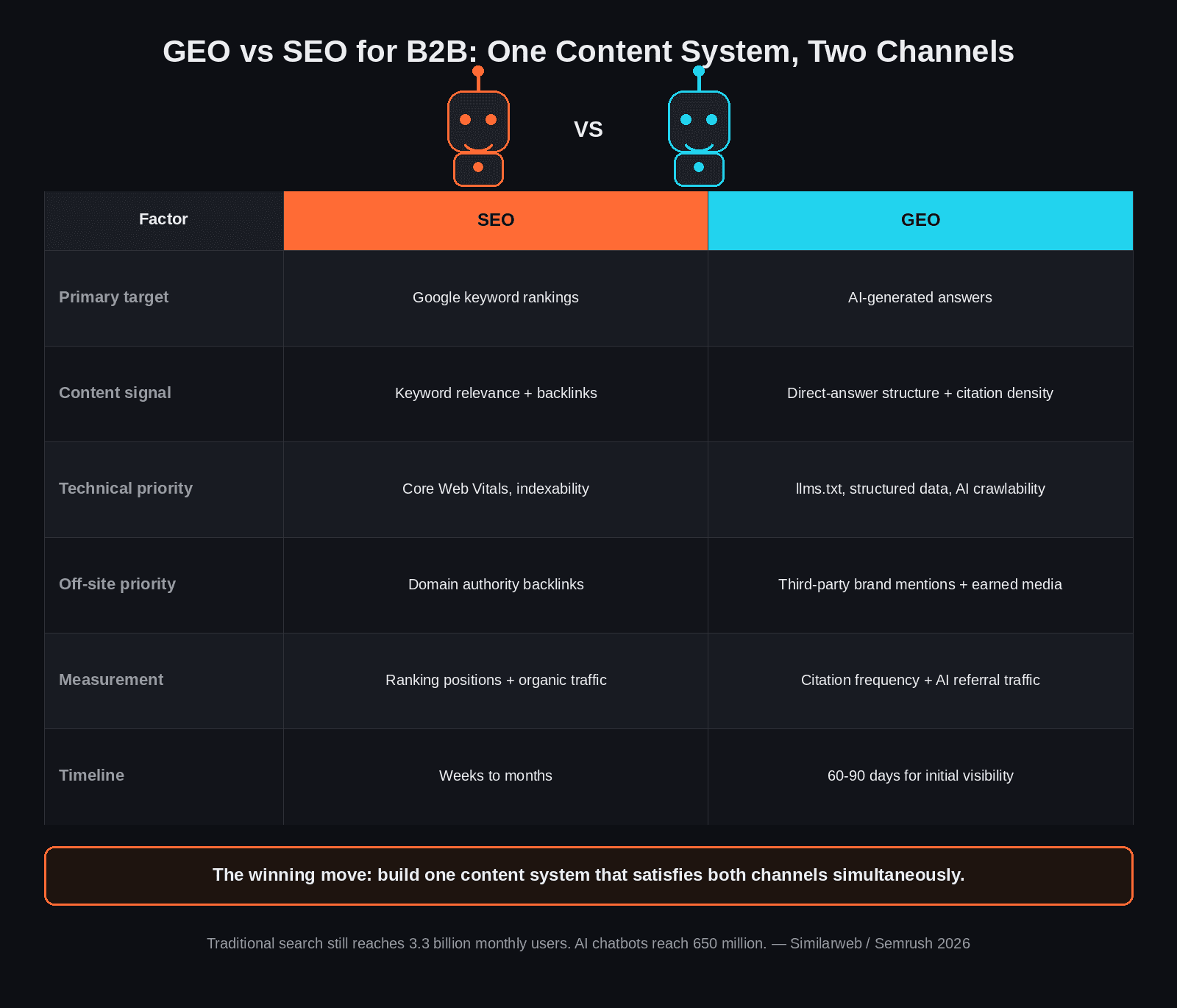
GEO and SEO are not competing strategies. GEO is the layer you build on top of a working SEO foundation. SEO ensures your content is indexed, crawled, and trusted by search engines. GEO ensures that when AI systems retrieve and synthesise content, yours is structured in a way they can extract and confidently cite.
The overlap between the two is not a coincidence. Both disciplines reward identical inputs: precise heading structures, citations from authoritative external sources, schema markup, and content that answers a specific question directly rather than burying the answer in setup. A well-built article optimised for Google's helpful content evaluation is already most of the way to being GEO-ready. What the two disciplines share is more significant than where they diverge.
Where they diverge is at the margin. SEO prioritises backlink acquisition, click-through signals, and keyword coverage across a full topic cluster. GEO prioritises direct-answer formatting, FAQ sections written as standalone extractable snippets, and third-party corroboration so AI retrieval systems have enough confidence to cite you. You do not need two separate content strategies. You need one strategy that applies both sets of criteria from the start. Stacker's March 2026 research found that earned media produces a 239% median lift in AI citations, with the underlying mechanism being domain authority built through consistent SEO investment over time.
Why do B2B brands that rank on Google get cited more in AI search?
Because AI retrieval systems use the same trust signals as search engines. Domain authority, backlink quality, content depth, freshness, and crawl coverage all determine whether an AI model treats your content as a credible source worth surfacing in a generated response.
Stacker's March 2026 research makes the mechanism explicit: 64% of all AI citations come from third-party sources, not brand-owned pages. The most efficient path to AI citation is not publishing more content on your own domain. It is earning coverage from sources that already carry authority: press mentions, analyst reports, review platforms, and industry publications. A brand with strong Google rankings has accumulated those signals by definition, through inbound links from credible domains, consistent crawl depth, and content that has been evaluated as trustworthy over time.
When ChatGPT or Perplexity generates a response about your category, they draw on a retrieval layer built from exactly those signals. A brand with no SEO foundation starts the GEO process at a significant deficit. It is not impossible to earn AI citations without strong search rankings, but it requires substantially more external validation to compensate. According to Forrester 2026, 94% of B2B buyers now use AI at some point in their purchase process, which means the AI citation channel is no longer niche. The brands positioned to appear there are the ones that built their search foundation first.
What content works for both Google and AI search?
Direct-answer content, precisely structured, performs well in both channels simultaneously. A heading written as a specific question, followed by a 40 to 60 word direct answer before any context or setup, is treated by Google as a featured snippet candidate and by AI systems as an extractable fact worth citing. The same piece of content does both jobs without any duplication of effort.
The formats that compound across both channels:
- FAQ sections with specific query-pattern questions and concise standalone answers that function as independent snippets
- Comparison content using named criteria and named sources, not vague generalisations about industry norms
- How-to content broken into numbered steps, each with a specific, actionable instruction rather than a general direction
- Stat-dense content where every claim has a named source cited in the sentence itself, not buried in a footnote or end reference
- FAQPage, Article, and HowTo schema markup: these signal extractable structure to both Google crawlers and AI retrieval layers, and they are free to implement
What does not work is content written to fill space. Thin content, padded sections, and generic category overviews score poorly under Google's helpful content evaluation. AI retrieval systems ignore them for the same reason: they do not contain extractable, citable facts. The logic is identical in both channels. Earn attention by being the clearest, most direct, most credible answer to a specific query. According to Similarweb 2026, AI chatbot traffic grew 57% year over year. Brands investing in structured, substantive content are compounding that advantage as query volume across both channels continues to increase.
Should B2B brands prioritise GEO or SEO in 2026?
Neither in isolation. For most B2B founders, the right sequence is to fix your SEO foundation first if it is broken, then build the GEO layer on top. If your site has indexing problems, thin content, or no meaningful backlink profile, GEO optimisation will not compensate. You are formatting content for extraction from a domain that AI systems do not yet trust enough to cite.
If your SEO foundation is solid, the GEO upgrade is a formatting and distribution job. Restructure existing high-performing content with direct-answer openers, FAQ blocks, and FAQPage schema. Run earned media campaigns to build third-party corroboration from credible sources in your category. Those two moves, applied to content that already ranks, are the most efficient path to AI citations for a B2B brand that has already done the search work.
New content should be built for both channels from the start: pillar articles targeting high-intent B2B queries, structured with GEO formatting, published with schema, and distributed through channels that generate backlinks. One well-built piece of content can rank on Google, earn featured snippets, appear in AI-generated responses, and generate inbound links that raise the whole domain. That compound return only comes from treating GEO and SEO as a single infrastructure, not two competing line items in a marketing budget. According to Forrester's 2026 Buyers Journey Survey, 94% of B2B buyers used AI during their most recent purchase, and that share will continue to grow as AI tools become the default starting point for category research.
Part of the GEO for B2B guide
This article is part of our GEO for B2B: How to Go from Invisible to Cited in AI Search pillar guide, which covers the full strategy for building AI citation authority alongside traditional search.
- GEO for B2B: How to Go from Invisible to Cited in AI Search — the complete framework for B2B brands building AI search visibility from the ground up, including channel structure, content formats, and distribution strategy.
- The Technical GEO Foundation: What Your Website Needs Before AI Can Cite You — the infrastructure checklist covering schema markup, llms.txt, crawl health, and structured data that determines whether AI systems can extract and cite your content at all.
- What AI Actually Needs to Recommend Your B2B Brand (It's Not More Content) — why third-party corroboration matters more than publishing volume for AI citations, and what clarity, consistency, and corroboration mean in practice for B2B brands.
Frequently asked questions
Is SEO still worth investing in for B2B in 2026?
Yes. Traditional search still reaches 3.3 billion monthly users, according to Similarweb 2026. B2B buyers continue to use Google throughout the research process, from early category discovery to late-stage vendor validation. The case for SEO has not weakened; it has been extended by the need to add GEO on top of a working search foundation. Cutting SEO investment to fund GEO is a trade-off with no strategic upside.
Can a B2B brand earn AI citations without strong Google rankings?
It is possible but significantly harder. AI retrieval systems use domain authority, backlink quality, and crawl coverage as trust signals, which are the same signals built through consistent SEO over time. Stacker's March 2026 research shows 64% of AI citations come from sources already ranking on Google. A strong search foundation is the most reliable starting point for AI citation authority.
What is the practical difference between GEO and SEO content for B2B?
SEO focuses on ranking signals: keyword coverage, backlinks, and click-through rate. GEO focuses on extractable structure: direct-answer headings, FAQ blocks, schema markup, and third-party corroboration. Both reward authoritative content that directly answers a specific question. GEO is the formatting and distribution layer you add on top of a solid SEO foundation, not a separate content discipline requiring its own strategy.
How quickly do GEO changes affect AI citation rates for B2B brands?
AI citation visibility typically lags behind Google ranking by weeks to months, depending on how frequently AI retrieval systems re-crawl and re-index your content. Brands with existing domain authority and strong backlink profiles tend to see improvements faster because the trust signals are already established. Earned media campaigns that generate third-party mentions from credible category sources can accelerate the timeline by building corroboration quickly.
Do B2B brands need separate content teams for GEO and SEO?
No. The most efficient approach is content built for both channels from the start: direct-answer structure, FAQ blocks, schema markup, and cited statistics in every article. A single well-built piece of content can rank on Google, earn featured snippets, and appear in AI-generated responses. Separate teams and strategies double the workload without doubling the return. One content system, applied consistently, serves both channels.